Learning, Brains & How To Make a Paper Airplane
When's the last time you made a paper airplane? If you can't remember (or have never made one), it might be time! Play is not just for kids.
With one sheet of paper and a couple of minutes, you can create a piece of aerodynamic architecture that will fly through space a few feet or several yards. The longest recorded flight is over 100 yards (December 2025). Amazing!
With a few sheets of paper, you can challenge friends, family, or colleagues to see whose plane has the longest flight. You can tinker with your design and try other models for hours of fascination. And if your plane is not up to par, recycle it and try again. Jump to instructions.
Learning & Play for Health
Scientists have determined that it's important to challenge yourself mentally as you age to keep your brain physically healthy (references listed under Resources below). Active learning and trying new things helps your brain stay flexible. This is called neuroplasticity, when your brain is physically activated at the neuron level, creating new neural pathways. Exercising your brain helps with thinking, learning, memory, and recovery from injury.
Scientists are also learning that play helps reduce anxiety and supports the nervous system.
And so we invite you to make a paper airplane, have fun, and feel good knowing you're healthier as a result! You can also take a class, of course, to enjoy the myriad benefits of learning something new.
Instructions for a Classic Dart 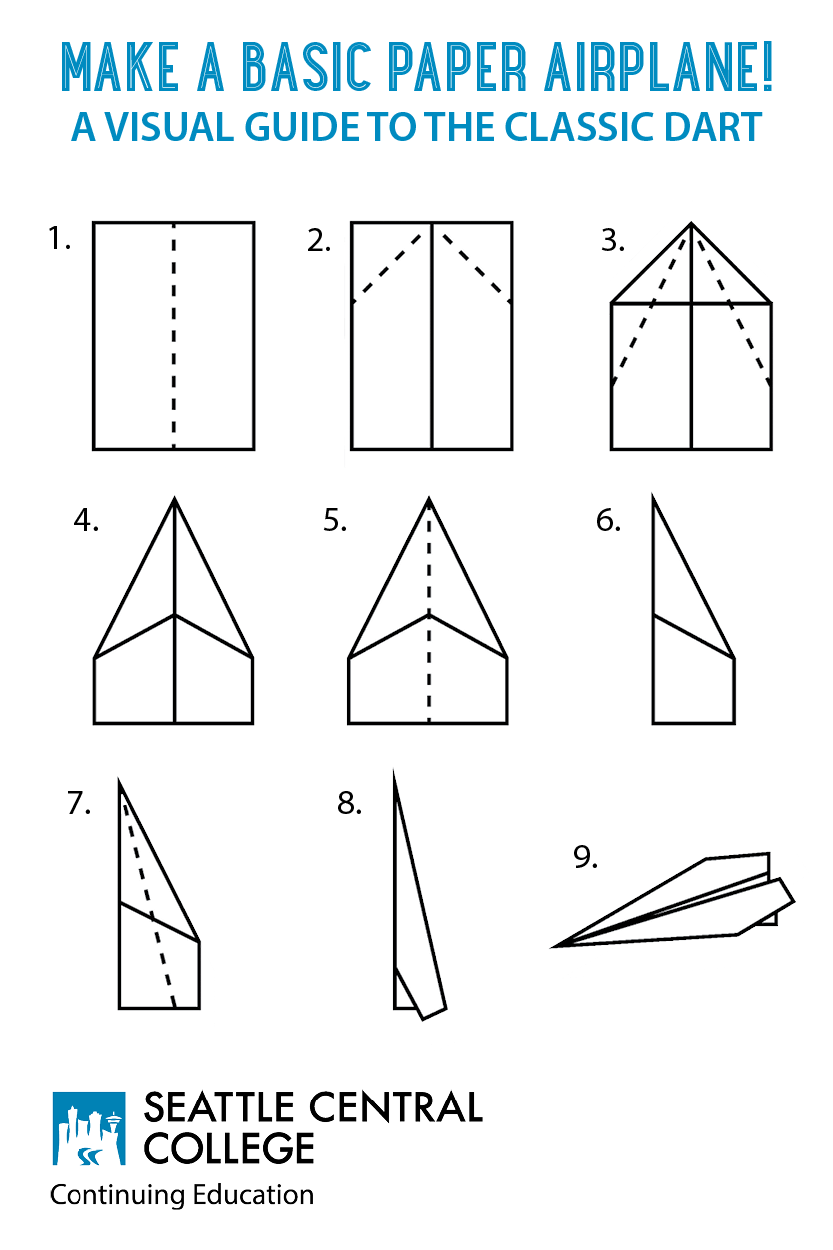
This is the quintessential paper airplane that can be made in a jiffy. See the diagram for a visual aid with corresponding numbers, and scroll down for links to other models.
1) Fold and crease your paper in half vertically and then unfold it so it's flat.
2) Fold each of the top corners down to meet the center line, making a solid crease along the edges and forming a point at the top.
3) & 4) Fold top edges down to the center line to make the nose sharper and the body thinner.
5) & 6) Fold the body in half along the center line, making sure the wings are even.
7) & 8) Fold the wings downward so the edges align with the bottom of the body.
9) Fold the wings up to be parallel to the ground. Voila!
Tips
- Symmetry. Hold the body of the plane while adjusting the wings to be parallel to the ground before launch for a straight, horizontal flight.
- Bend the rear corners of the wings upwards slightly to help the plane stay level.
- Weight. If the plane dives or stalls, add one (maybe two?) paperclips to the nose.
- Gentle launch. Try a gentle toss, rather than throwing it hard upwards or downwards.
- Avoid drafts and obstacles. Try your plane indoors with plenty of space, if possible, to avoid drafts.
- Observe your plane in flight and tinker with it to get a better result.
Feel free to document your airplane trials and send us a short video! Email: conted.central@seattlecolleges.edu
With your permission, we might share it on social media to inspire others.
Have FUN!!
____________
Resources on Paper Airplanes
There are many other models to try that will give you a wide array of results. Here are some options:
- Fold N Fly for photo-based instructions
- Foldable Flight You Tube for video-based instructions
More Resources on Learning & Brain Health
- Playfulness and Play for Adults, Ontario Psychological Association
- Brainwork: The Power of Neuroplasticity, Cleveland Clinic
- Neuroplasticity 101, Brain Futures
- Edutopia: Neuroscience, Brain-Based Learning & Neuroplasticity
- Simply Psychology: Brain Plasticity
- Discover Magazine: How Learning a Language Changes Your Brain
- Forbes: Four Underlying Principles to Changing Your Brain
- Very Well Mind: What is Brain Plasticity
- Positive Psychology: Neuroplasticity
- Sentis Brain Animation
By Liza Burke, Marketing Manager, Spring 2026